Generative engine optimization: a practical site audit, with evidence
Generative engine optimization is the work of getting a site found by Google and cited by AI assistants such as ChatGPT, Gemini, Claude and Perplexity. The basics are those of SEO, read more strictly: the site must be readable, the business clear, every service answering in its first lines. Nobody can guarantee a citation; a serious audit says what improves the odds and proves it with evidence.
I ran 14 audits by hand this summer, on firms and businesses in Italy and the US, before writing the method down as a procedure. Below: what Google and assistants read, the nine checks that matter, which bots not to block, how to count citations honestly, how to order the fixes, and the mistake I watched an AI agent make on my own site.
What changes between SEO and GEO?
Google shows a list of pages; an assistant writes an answer and cites few sources. Google's guidance on AI features in Search says the same SEO practices apply: helpful content, indexable pages, readable text. To be cited, though, it matters more that the answer sits at the top of the page and that it is clear who you are, what you do and where.
Which checks should you run?
- the site can be read: 200 response, text present, not only JavaScript;
- robots.txt does not block the search bots you want;
- title and description state service and place;
- the answer to the client's question is in the first lines;
- the business is clear: who, what, where, for whom;
- each service has its page, reachable from the home;
- structured data is consistent with what is visible;
- contacts and place are identical everywhere;
- there is a proof: numbers, reviews, cases.
Which AI bots should you not block?
Many sites block every AI bot to stay out of model training, and disappear from assistant search too. They are different bots and can be treated separately. OpenAI uses OAI-SearchBot to surface sites in ChatGPT search and GPTBot for training; Anthropic uses Claude-SearchBot for search and ClaudeBot for training.
| Bot | Whose | What for |
|---|---|---|
| OAI-SearchBot | OpenAI | surfaces sites in ChatGPT search |
| GPTBot | OpenAI | training |
| Claude-SearchBot | Anthropic | Claude's search results |
| ClaudeBot | Anthropic | training |
Allowing search and refusing training is a legitimate choice. The audit flags only rules that block search bots the business wants.
The most common mistake of an AI-run audit
On 7 October I had a low-cost AI agent audit this site, following my own procedures. It wrote that the meta description and structured data were missing, and added percentages of lost traffic. Both were there: the agent had read the page's extracted text, which does not show markup, and concluded it was absent.
The rule was already in the procedures: extracted text cannot prove a tag is missing. Writing it was not enough. On the second run I gave it a script that reads the real HTML: it read the home correctly, but still wrote "missing meta description" on three pages whose HTML it had not opened. On the third run I made a check mandatory: it rereads the report, opens the HTML of every page cited and blocks any claim the HTML contradicts or that names no URL. Five fixes, each with its page and its evidence, all true.
How do you count citations?
With ten questions a client would ask, put to the assistants they use, in a fresh chat. Log every answer: date, assistant, question, whether the site is named, which page is cited. Then count with the denominator: "named in 3 answers out of 10", never a percentage alone. One answer is a snapshot, not a ranking: repeat the test monthly with the same questions.
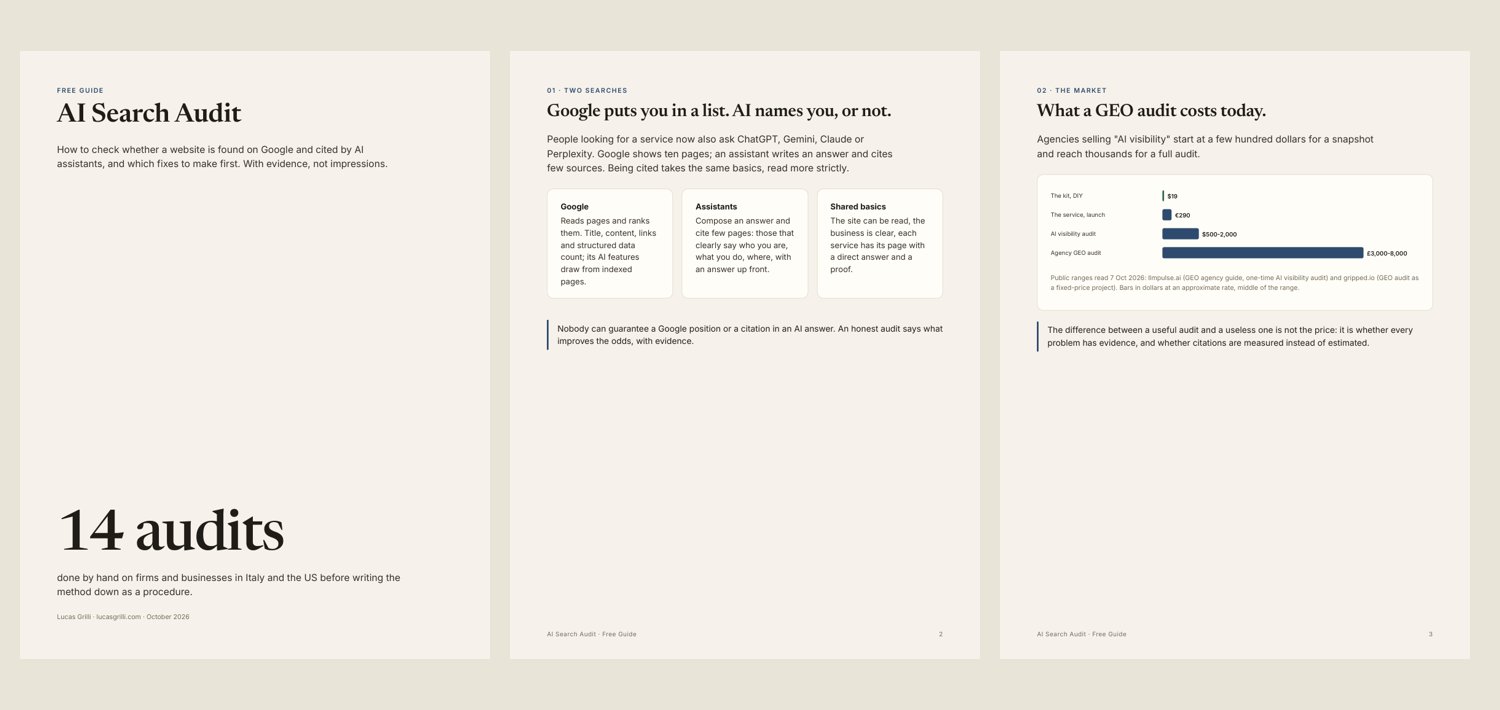
What does a GEO audit cost?
Public prices of a GEO audit
The difference between a useful audit and a useless one is not the price. It is whether every problem has evidence, whether citations are measured instead of estimated, and whether every fix comes with the check that tells you it worked.
How do you decide what to fix first?
Every fix gets three scores: impact from 1 to 3, ease from 1 to 3, confidence in the evidence from 0 to 1. Priority is the product. In the test of the method on a professional firm, the best fix was a more direct answer at the top of the specialist page: 2 times 2 times 0.4, priority 1.60. Low confidence, because the benefit was not measured, and that is written down.
Structured data helps machines read the page, but guarantees neither rich results nor citations: keep it consistent with what is visible, not as a shortcut.
Frequently asked questions
- What is generative engine optimization?
- It is the work of getting a site found by Google and cited by AI assistants. The basics are those of SEO, read more strictly: a readable site, a clear business, an answer at the top of every service page.
- Can anyone guarantee ChatGPT will cite me?
- No. You can improve the odds and measure the result with the same questions before and after the fixes, counting citations with the denominator.
- Should I block GPTBot?
- It is a choice: GPTBot is for training, OAI-SearchBot is for ChatGPT search. You can refuse the first and allow the second.
- Can an AI run the audit by itself?
- Yes, if it follows firm rules: no problem without evidence, markup judged only from real HTML, no invented percentages. Without a final check, a low-cost model gets exactly these points wrong.
Where to start
The free guide, the kit with the procedures and the final check for your AI agent, and the service are on the AI Search Audit page.
And a real question: have you ever asked ChatGPT who is the best in your field in your city? What did it answer?
Videos, automations and a second brain for people who work with Claude, built in public on lucasgrilli.com and GitHub.