Claude Code free with OpenRouter: setup, limits and real costs
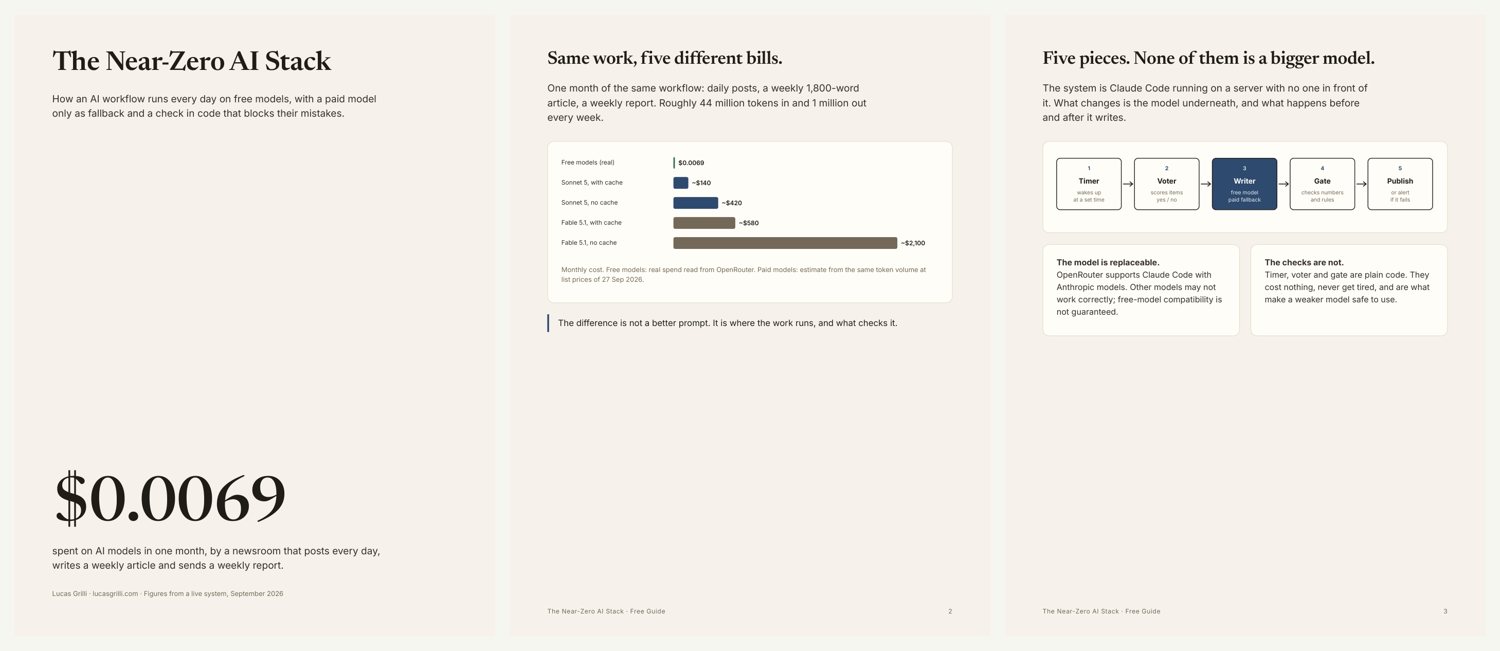
Claude Code free of model charges is possible in a tested setup: connect it to OpenRouter and try a free model. This is outside the officially supported Anthropic integration. My automated newsroom spent $0.0069 on models from September 1 to 27, 2026. Server costs are separate.
On September 27, I checked the account: $0.0069 spent that month and 461 free requests used on a day that included extensive testing. My estimate for the same workload on Sonnet was about $140 to $420 a month.
Here is the configuration, the limits, the failures I found, and the checks that make the workflow useful.
Is Claude Code free?
The application can be installed without paying. The model normally requires a Claude subscription or paid API usage. What you can change is where Claude Code sends its requests. OpenRouter gives access to different models through one key, including models with :free in their names.
The limitation matters: the official OpenRouter guide guarantees the integration only for Anthropic models through the first-party provider. Non-Anthropic models are not officially supported through the native endpoint. My NVIDIA setup is a working case documented on September 26 and 27, not a promise that every free model will work for you.
How do you connect Claude Code to OpenRouter?
Create a key on the Keys page. This shell example uses an OpenRouter key variable plus the three Claude configuration values:
export OPENROUTER_API_KEY="your-key"
export ANTHROPIC_BASE_URL="https://openrouter.ai/api"
export ANTHROPIC_AUTH_TOKEN="$OPENROUTER_API_KEY"
export ANTHROPIC_API_KEY=""
claude --model nvidia/nemotron-3-ultra-550b-a55b:free
ANTHROPIC_API_KEY must be explicitly empty. If you previously signed in with an Anthropic account, clear the cached session with /logout, restart and check /status. Confirm that requests appear in OpenRouter's activity log. Test the example model before giving it a real job.
For unattended work, the command is claude -p "the task". Running without someone watching makes failure alerts more important.
Which free models should you test?
Claude Code needs tool use: it reads files, writes files and runs commands. My setup uses NVIDIA Nemotron 3 Ultra, followed by Nemotron 3 Super. Availability changes. Check the current free-model catalog, then test your exact workflow.
I keep two free options and a paid fallback. A second name in a file does not prove the fallback works. It has to finish a test task and leave evidence in the logs.
What are the limits of free models?
| Limit | What it means |
|---|---|
| 50 requests a day | Before purchasing credits, according to the OpenRouter FAQ. |
| 1,000 requests a day | After purchasing at least $10 in credits. Free requests do not spend those credits. |
| Provider privacy | Training and retention policies vary. Review the provider policies and privacy filters. |
| Compatibility | Tool calls and built-in features need testing. Native non-Anthropic integration is unsupported. |
| Quality and availability | Outputs can contain errors, break the format or stop halfway through a job. |
My day with 461 requests fitted inside the 1,000-request allowance. Your workload may not. Count requests across the account and measure a representative day before scheduling production work.
How do you catch mistakes before using the output?
I use two rules that can be checked outside the model:
- A task is finished when its output passes a check written in code. My publishing check looks for every number in the cited sources. An unsupported number blocks publication and sends the text back for correction.
- Failures move through a fallback chain. Try the second free model, then the paid model. If all attempts fail, send an alert instead of silently publishing or abandoning the task.
On September 26, the files said the paid fallback was enabled. The logs showed it had failed four times out of four because the subscription had reached its weekly limit. The post came out only because the free model succeeded. Configuration was not proof of reliability.
The check has boundaries. That day, a text said a rating agency had “upgraded” Italy when it had affirmed the rating. The numbers were correct; the verb was wrong. A numeric check catches numeric errors. It does not establish that every statement is true.
How much can you actually save?
One workload: recorded model cost and monthly estimates
The server costs about €8 a month and is separate. The domain and other services are separate too. The model bill is the measured part of this case, not the total cost of running a business.
If you use Claude Code for ten minutes of interactive work a day, a subscription may remain the easier choice. This method is more relevant when a repeatable task runs unattended every day. Measure your current bill and output quality, then compare the same task with the alternative.
Which jobs fit this approach?
Start with public, repeatable work whose output can be checked: news summaries, document classification, data extraction, drafts and recurring reports. Keep client information and secrets out of this example. A paid provider still needs an appropriate data policy. Difficult reasoning and outputs that cannot be validated need a different level of review.
On September 29, I tested the example on a clean server: 20 news items were read and selected, a summary was written and checked in about three minutes, and model charges were $0. That proves the example ran. It does not prove every customer's task will produce the same result.
Frequently asked questions
- Is Claude Code free?
- The application can be installed for free, but its default models require a Claude subscription or paid API usage. Free OpenRouter models can be tested as an alternative. OpenRouter guarantees its Claude Code integration only for Anthropic models through the first-party provider. Non-Anthropic models are not officially supported through the native endpoint.
- How many free requests does OpenRouter allow each day?
- Free models allow 50 requests a day before you have purchased credits. After purchasing at least $10 in credits, the limit rises to 1,000 requests a day. Free-model requests do not consume those credits. Check the current limits before planning a recurring workflow.
- Can I send private information to free models?
- Do not assume a free provider has the data policy your work requires. Check provider retention and training policies, configure the privacy filters, and verify the provider serving the request. A paid model is not automatically private either. Keep client information and secrets out of this example workflow.
- Which free model should I test with Claude Code?
- Choose a model that supports tool use. My documented setup uses NVIDIA Nemotron 3 Ultra with Nemotron 3 Super as a second option. This is a tested case, not a compatibility guarantee. Check current availability and test permissions, tool calls and output before relying on it.
Where to start
The free guide, the complete files for your AI agent and the implementation service are on The Near-Zero AI Stack page. The complete product includes the model chain, the numeric check and the example tested above.
Which AI task do you run every day, and what does it currently cost? Tell me the actual job. I want to see whether a free model can handle it with a useful check.
Working examples of AI automation, video and a second brain are on lucasgrilli.com and GitHub.