How to write a case study of technical work: two stories, the same numbers
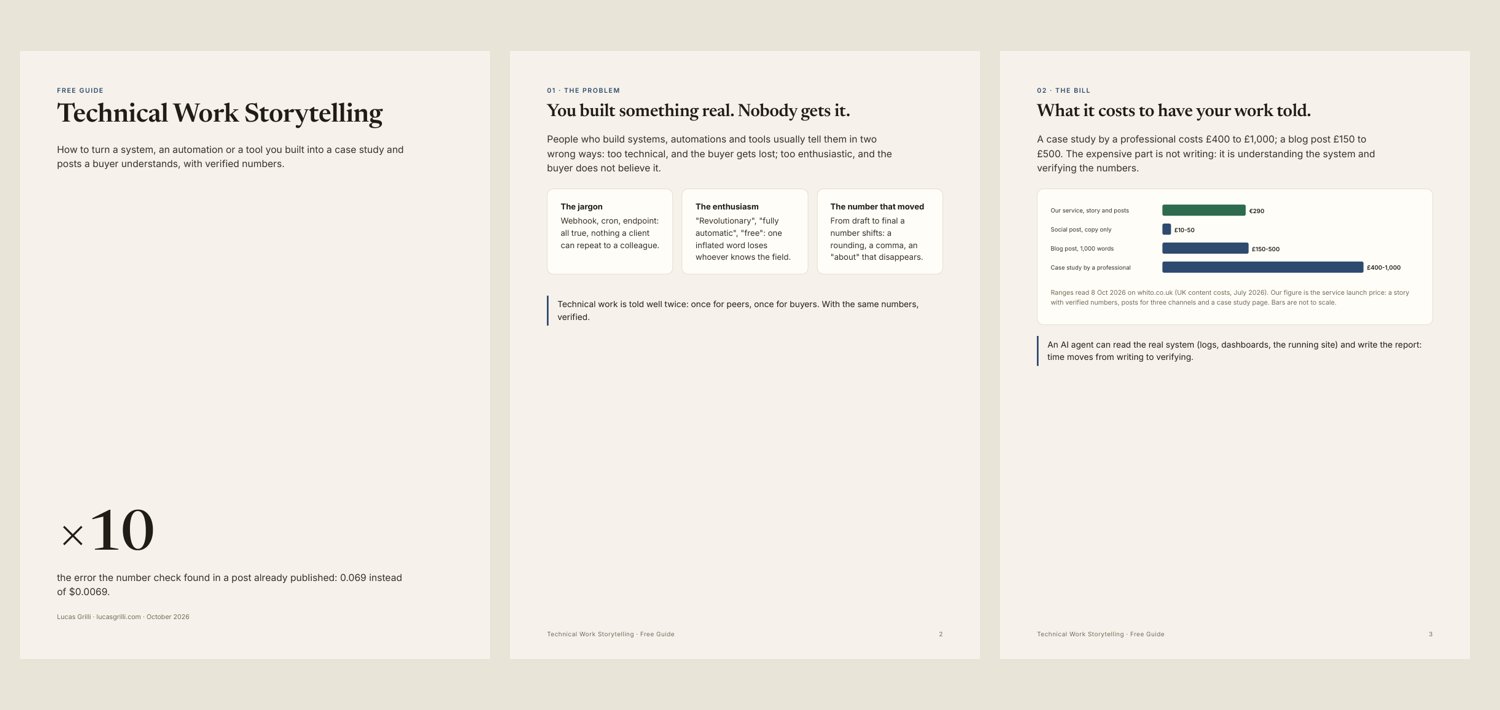
How to write a case study of technical work? Tell the same system twice, once for peers and once for buyers, with the same verified numbers. The weak point is usually not the writing: it is a number that changes on the way. I ran one of my published posts through a number check and found a spend written ten times bigger than the real one.
Start from the running system
Not from the builder's memory. Logs, dashboards, the site, the providers' APIs: what you see today gets the label [V], verified. What you find only in files or in the builder's words gets [D], declared. Calculations get [S], estimate. No label, the number does not go in.
What goes in
| Section | Question it answers |
|---|---|
| card | what starts it, where it runs, with which tools, what it costs |
| flow | what happens, step by step, and who does it |
| choices | why it is built this way, what was discarded |
| numbers | every figure with source and label |
| mistakes | what went wrong and the rule it produced |
| what surprises | what builders take for granted |
| what not to say | sentences to avoid in posts |
Two stories, the same facts
One technical paragraph for peers: components, choices, numbers. One plain story for someone who uses ChatGPT but is not technical: "a rented computer on day and night" instead of VPS, "an AI that only acts as editor-in-chief" instead of classifier. No term without an explanation, no adjective instead of a number.
The number that moves
On 27 September I wrote a 16-section report on the automated newsroom of one of my projects: the month's model spend was $0.0069, verified on the provider. On the 28th I published the launch post, rewritten by hand from the draft. On 8 October I ran the post through the check: it said 0.069. Ten times as much, slipped in during the rewrite. The check looks for every number of the post in the report, digit by digit: 0.069 and 0.0069 are different numbers.
The same check blocked a second number, "over 4,700 euros more every second": it came from the site's counter, not from the report. The check asks for one of two things: add it to the report with its source, or take it out. The other six numbers in the post were found in the report and passed; years are left out.
When to run the check
Twice: on the draft, and again on the final text after the rewrite by hand, because that is where the tenfold error slipped in. The check sorts every number into three groups: found in the report, blocked, or to be labelled as an estimate.
What it costs to outsource
In the UK a case study by a professional costs £400 to £1,000, a 1,000-word blog post £150 to £500, according to whito (July 2026). The expensive part is understanding the system and verifying numbers, not writing.
What it costs to outsource the writing
What not to write
- "all free", if models cost even a few cents;
- audience numbers presented as traction;
- "fully automatic", if a person checks;
- the brand of someone who did not choose to appear.
Frequently asked questions
- How do you write a technical case study?
- Start from the running system, write a report with card, flow, choices, labelled numbers and mistakes, then two stories (technical and plain) and a list of what not to say. Posts come from the report.
- How long should a case study be?
- 600 to 1,200 words for the public page, with one table or diagram; the report behind it is longer and stays internal.
- How do you avoid wrong numbers?
- Every number in the public text must appear in the report with the same digits; run the check again after the rewrite, because that is where numbers move.
- Can AI write it?
- An AI agent can read the system and write the report and drafts; whoever signs rewrites in their voice and publishes.
- What does a number check find?
- Numbers in the post that are not in the report. In the real case, out of eight numbers, it blocked two: a spend ten times too big and a figure with no source in the report.
Where to start
The free guide, the kit for your AI agent and the service are on the Technical Work Storytelling page.
And a real question: what have you built that nobody has understood yet? Tell me.
Videos, automations and a second brain for people who work with Claude, built in public on lucasgrilli.com and GitHub.