How to find clients: the system that flags who is asking, for about $1 a month
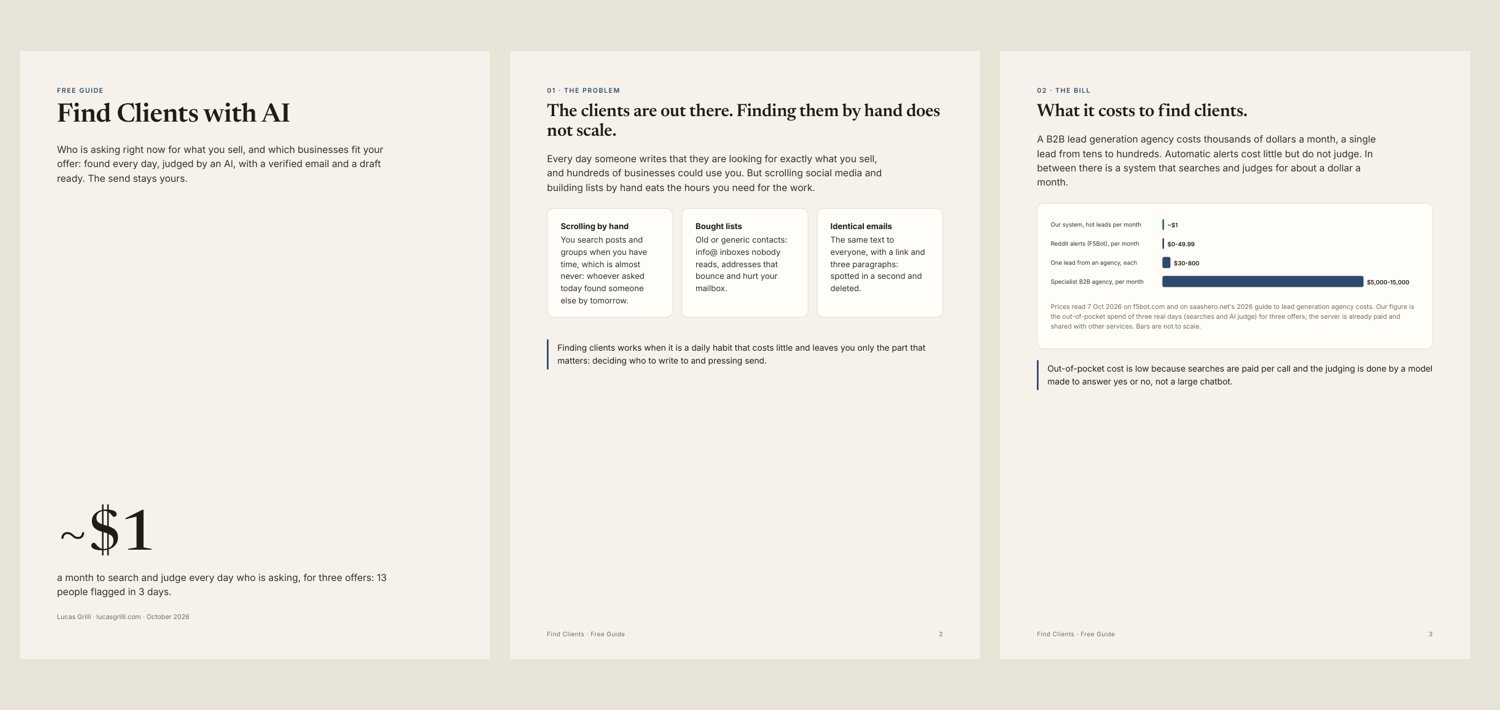
How to find clients? Look in two places every day: people who are asking right now for what you sell, and businesses that fit your offer. An AI can do both for a few cents: it searches social media, builds lists from Google Maps, judges who really buys, finds a person's email and verifies it, and prepares a short draft. The system I run for my own offers reads about 260 posts a day and costs about a dollar a month. I still press send, every time.
Where do clients ask for help?
On X and LinkedIn, in their own words: "looking for", "can anyone recommend", "too expensive", "I hate doing". Every morning a script searches those words for your offer, and each new post goes to an AI judge that answers four questions with a probability: is the author a buyer or a seller? Is there a concrete request? Would they do it alone? Does your offer solve it? Only people above the threshold reach you, and every post is remembered for 90 days so it is never paid twice.
In the first three days, for three offers, it flagged 13 people. Some days it flags nobody: on 30 September, for one offer, 101 posts read, 39 new, zero buyers. That is data, not a fault: it says the searches need changing.
What does it cost to find clients?
What it costs to find clients
The difference comes from two choices: searches paid per call instead of a subscription, and a judge made to answer yes or no instead of a large chatbot. On the real run the judge (Jev) costs about $0.17 a month; Claude Haiku on the same work would cost about $7.8, an estimate on the real tokens. The server is not counted: it is already paid and shared with other services.
How do you build a client list without buying one?
From Google Maps: a kind of business and a city, one search for a fraction of a cent. Then each website is read for free with Jina Reader: published emails and an excerpt from which the AI writes whether the business fits, why, and one true line about it. When the site names the owner but not their email, likely addresses are built and verified.
Testing on real sites taught me two things: many businesses publish only a form, and some write from a domain other than their website. A dental practice in Austin has its site on one domain and its email on another: the tool now reads mailto links too.
Why verify emails before writing?
Because bounces hurt the mailbox you write from. On real sends of an outbound engine:
| Address | Bounces on real sends |
|---|---|
| verified valid | 1.4% |
| catch-all (risky) | 8.8% |
| unknown result | 7.3% |
| never verified | 10.3% |
And who you write to matters: 267 sends with 77% of the list on shared inboxes like info@ got zero replies. Since then a named person always comes first.
What does an email that gets read look like?
- under 75 words, no links or attachments;
- one true line about that business, from its website;
- your result, with a number;
- one question answerable in one word;
- follow-ups only to people you really emailed who did not reply.
In the US cold B2B email is allowed with your real identity, a postal address and a way to opt out (CAN-SPAM). In the EU and UK the rules are stricter without consent: check before writing to lists there.
What stays with you
Deciding who to write to and pressing send. The system finds, judges and prepares drafts in your mailbox; it never sends by itself. That is the part not to delegate: it is where you see whether a message is right for that person.
Frequently asked questions
- How do I find clients as a freelancer?
- Every day, in two places: people asking for what you sell on X and LinkedIn, and businesses that fit your offer on Google Maps. An AI can search, judge and prepare drafts; you write to the ones worth it.
- How much does it cost with AI?
- In my case about a dollar a month out of pocket for the hot leads of three offers; a Google Maps search about two tenths of a cent, an email check a fraction of a cent.
- Are AI-found leads qualified?
- They are judged: buyer or seller, concrete request, fit for the offer. Whether they buy, only their reply tells.
- Does the AI send the emails?
- In my system no: it prepares drafts in the mailbox and follow-ups for people who did not reply. I send, one by one.
Where to start
The free guide, the kit for your AI agent and the service are on the Find Clients with AI page.
And a real question: where do your clients come from today, and how many hours does it cost you? Tell me.
Videos, automations and a second brain for people who work with Claude, built in public on lucasgrilli.com and GitHub.