AI second brain for a small business: how to build one, and keep it alive
An AI second brain for a company is an archive of files the AI reads before every answer: who you are, what you sell, your clients and where you stand, dated decisions, recurring work. A new chat stops starting from zero. In the cold test I ran on 7 October, a session with no memory at all answered three questions out of three citing the right file, and on the third it said what was missing instead of inventing.
I work this way every day: my archive holds 27 projects and 21 crafts, and every chat reads it before answering. Below: the five pieces, the seven rules that keep it alive, what goes in first, how to test it, what it costs to have it built and where it is the wrong tool.
What is an AI second brain, in practice?
A folder of text files, on your disk or your drive. It is not software and it is not the assistant's memory. ChatGPT's or Claude's memory is personal and decides what to remember; here you decide what is written, it is the same for the whole team, it has dates, and every answer says where it comes from.
It works because assistants read well the files you give them at the start of a conversation. Anthropic calls the principle context engineering: give the model the right context, in order, instead of hoping it guesses.
What are the pieces?
- The rules: a file the AI reads first. I call it AGENTS.md, the format the main agents recognise; for Claude a CLAUDE.md pointing there is enough.
- The index: where everything is. A file no index names does not exist for the AI.
- The state: priorities, open work, next steps. Only the present.
- Clients and procedures: one folder per client with the agreements made; quote, onboarding, report and handover written once.
- The decisions: a log with date, who, what and why.
Which rules keep it alive?
Anyone can create folders. The problem comes a month later, when the archive says old things and the AI repeats them confidently. I use seven rules:
- a fact lives in one file; others link to it, never copy it;
- state holds only the present: what gets replaced goes to the archive with a date;
- every decision that lasts more than a day is written with a date and a name;
- every new file gets a link in its index;
- raw documents come in through one door and get sorted;
- if the AI is wrong because a file is old, fix the file, not the answer;
- passwords, bank details, health data and personal documents stay out.
What goes in first?
You do not need the whole archive on day one. You need the six things the AI asks you most often: who you are and who you work for, offer and prices with what you do not do, active clients and where you stand, decisions still in force, three to five procedures for recurring work, two well-written emails for the tone. About twenty minutes of interview and the documents you already have.
How do you know it works?
With a cold test: open a new chat, one that remembers nothing, on the archive, and ask three questions built on what is written. Every answer must be right and cite the file. In my test on an example company the questions were the price of a product, the discount agreed with a client, and whether a new client could get 15%.
| Question | Answer from the new chat |
|---|---|
| What does a workstation cost? | 1,200 EUR, from the offer file |
| Discount agreed with the client? | 8% until 31 Oct, from the client folder and the decision log |
| Can I give 15%? | the rule above 10% is missing: it says so and names where to write it |
The third answer matters most. An AI without an archive would have said something plausible. This one found the gap and flagged it.
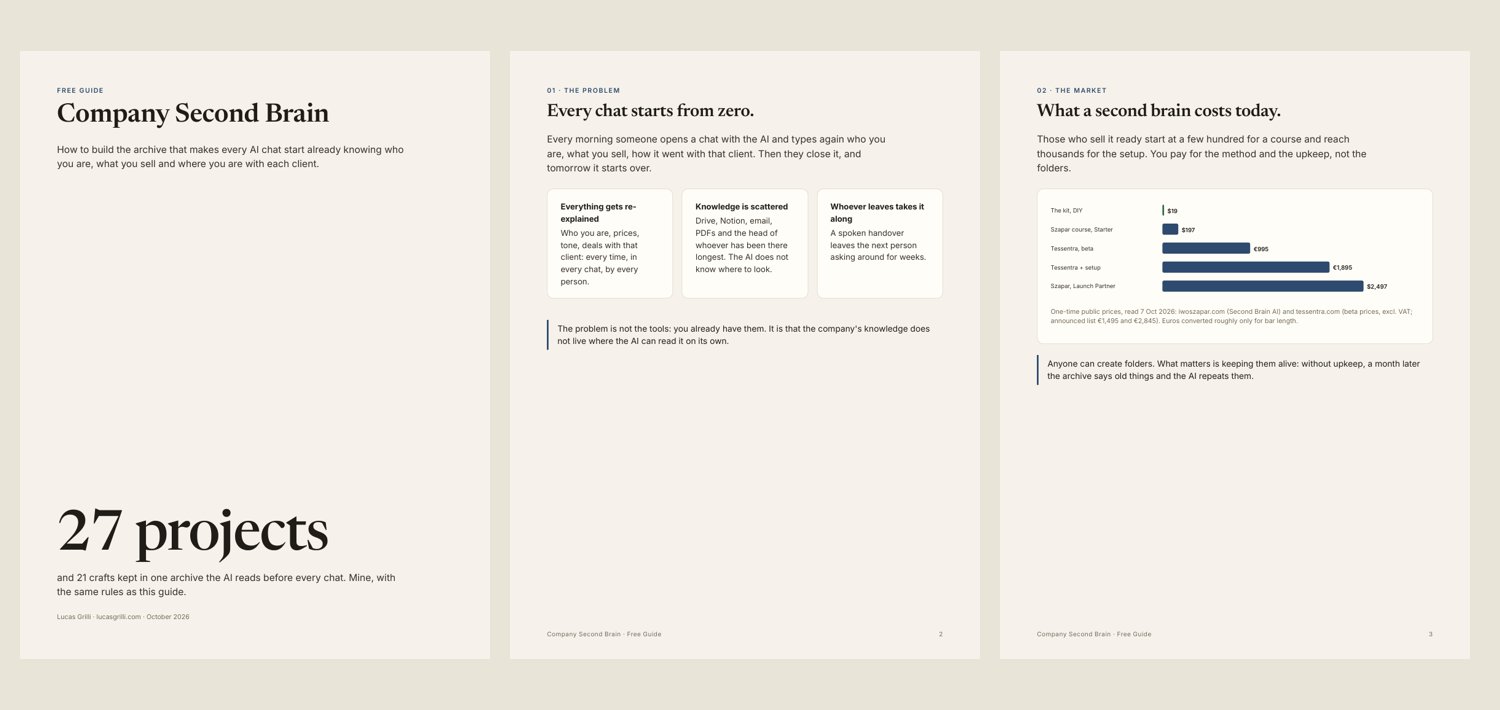
What does an AI second brain cost?
Public prices of a ready-made second brain
You pay for the method and the upkeep, not the folders. That is also why the part I would never skip is the last: fifteen minutes a week to sort new documents, keep the state to the present and remove duplicates.
Which assistant does it work with?
Claude and ChatGPT, on the same archive. With Claude Code or Cowork opened on the folder the AI reads and updates the files itself. In a Claude project or a ChatGPT project the files are uploaded as knowledge, and when they change they must be uploaded again: the most common practical limit.
When it is the wrong tool
- If nobody in the company uses AI yet: the problem it solves is not there.
- If you need a CRM or ERP: this is an archive to read, not a sales database.
- If several people must edit the same files at the same moment.
- If nobody will have fifteen minutes a week: without upkeep it goes stale.
Frequently asked questions
- What is an AI second brain for a business?
- An archive of text files the AI reads before every answer: who you are, offer and prices, clients and state, dated decisions, procedures. Every chat starts from the right state instead of from zero.
- How is it different from ChatGPT memory?
- The assistant's memory is personal and decides what to remember. A company second brain is written by you, the same for the whole team, dated, and every answer cites the file it comes from.
- Does it work with ChatGPT and Claude?
- Yes, on the same archive. The rules live in AGENTS.md; with Claude Code or Cowork on the folder the AI updates files itself, in Claude or ChatGPT projects changed files must be re-uploaded.
- How much time does it take?
- About twenty minutes of interview and your existing documents to start, then fifteen minutes a week of upkeep.
Where to start
The free guide, the kit with the ready archive for your AI agent and the service are on the Company Second Brain page. The kit has the archive in English and Italian, four procedures and the cold test.
And a real question: what do you re-explain to the AI most often? Tell me, it is usually the first file to write.
Videos, automations and a second brain for people who work with Claude, built in public on lucasgrilli.com and GitHub.