Free · Open source · The memory the AI reads by itself
What if your AI already knew
where you left off?
A free folder you paste into your assistant. From then on it knows who you are, what you are working on and what you decided yesterday, without you explaining any of it again. Open a new chat and it picks up where you left off.
Free. No email, no account. To uninstall it you delete a folder.
AI today
no context
With Context_OS
same model
Example projects, answers written out rather than recorded. The sources it cites are text files in your own folder: no software, no account. Tap a question to watch it.
You already have an AI that reasons well. You are still the one supplying the context.
Open a chat. It doesn't know who you are, what you're working on, what you decided yesterday. You explain everything again. Tomorrow you start over.
The more projects you run in parallel, the more this costs: time, tokens, and decisions that get lost because they stayed inside a closed conversation.
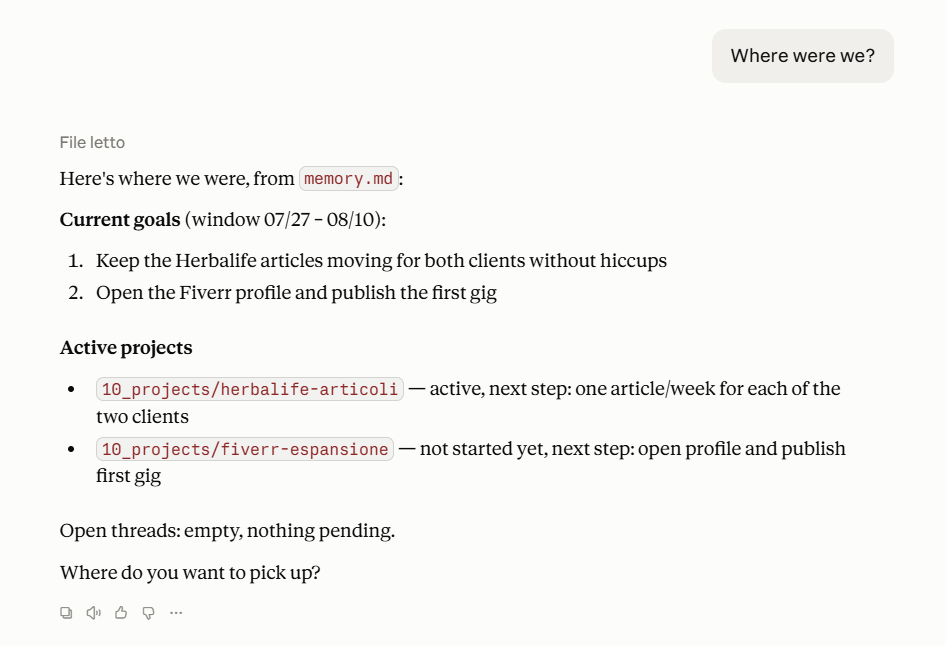
The proof is one screenshot.
A new chat, days later, in a conversation that knows nothing about the ones before it. I told it nothing: it read.
It installs with one prompt. Literally.
Create an empty folder, wherever you want on your computer.
Point your assistant at it: in Claude Code or Cowork, select it as the working folder.
Paste this and send it:
Download the zip of https://github.com/Lucas-Grilli/Context_OS (branch main) and extract its contents directly into this folder. Then delete the downloaded zip. Finally open CLAUDE.md, read the section "First action of every session" and follow it.
You are up and running. The system notices on its own that it is empty, asks you 3+1 questions, and works with you from there. Three minutes, timed.
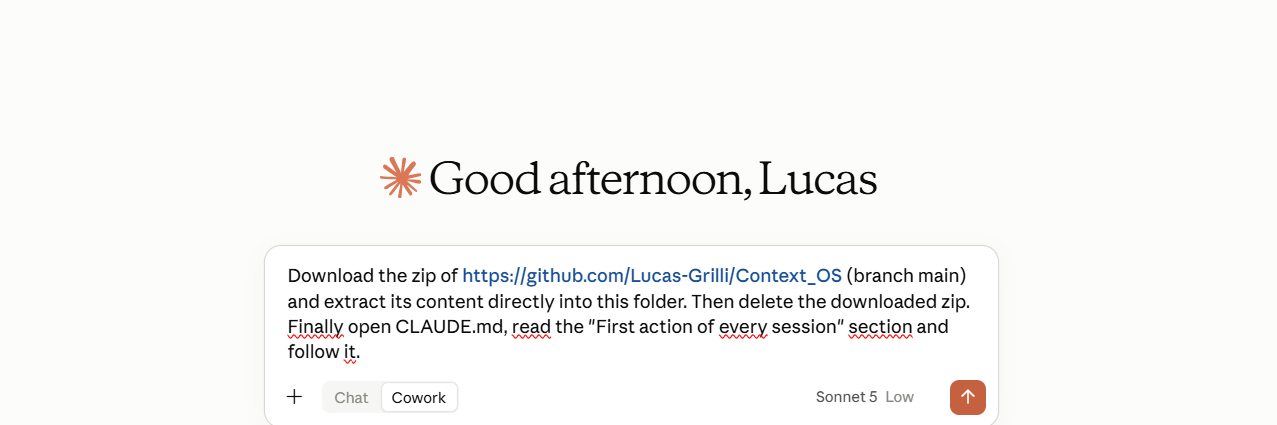
That's it. Do you work in Italian? The same folder exists in Italian.
Why it holds up as the folder grows.
The hard part of an archive isn't reading: it's not re-reading everything every time. The rules file never holds state, only the map to reach it. A request goes from the map to one index to one file, and the rest of the folder stays closed, even at hundreds of files.
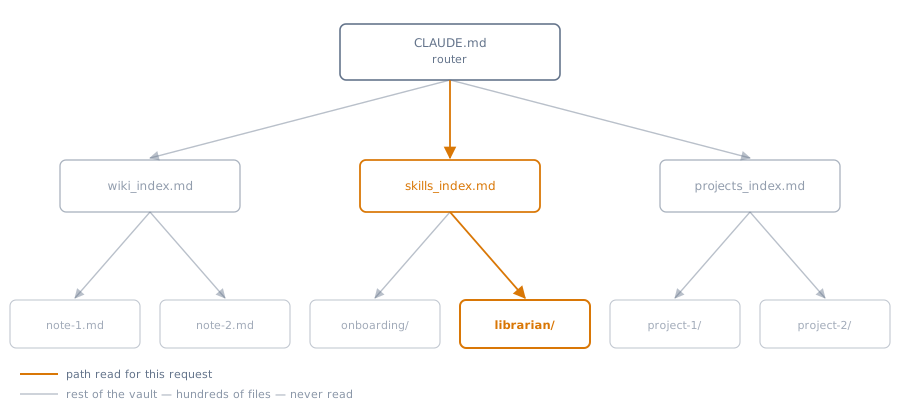
Rules, index, file: one path read per request.
Seven procedures it runs, not ones you read.
The three things you are thinking.
“I already have Notion, or Obsidian.”
Those are for you to re-read, which is exactly why you stop after three weeks. Here the reader is the assistant: it opens the folder by itself, before it answers you.
“The AI already has memory.”
It decides what to keep and you never see it, and it stays inside the product. Here the files are yours, you open them in any editor, and they stay yours even if you switch assistant.
“It will turn into a second job.”
The boring part — keeping indexes, knowing what sits where — is exactly the part it does. If you end up playing librarian by hand, the system has failed.
Who it is for
Not for someone with a single project they keep entirely in their head: that context is already there.
What it doesn't do
It isn't a demo. It's the folder I work in.
What you download is the skeleton of the system I run my own work on every day: same rules, same procedures, without my content inside.
My archive today holds 553 files and over 465,000 written words. A normal session reads a tiny fraction of it, because there is a map telling it where to look before it starts looking. That is the only difference that matters between an archive that speeds work up and one that slows it down.
Every correction I make to it goes back into the system, and from there into the version you download. That's why it is at version 1.4 and not 1.0.
Try it, and tell me where it breaks.
Worst case you lost three minutes, not money.